
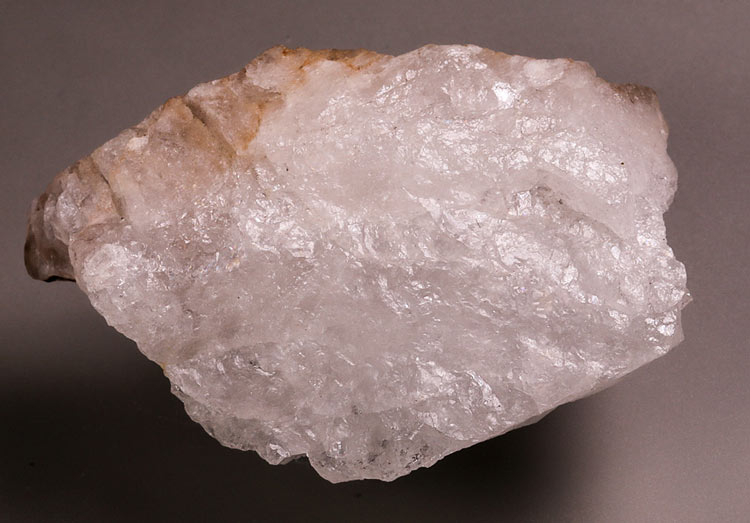
Na3Li3Al2F12
Clear as ice, the inner eye expands through the invisible veil
The name combines cryo (Greek κρύος — frost, ice), a reference to the parent mineral cryolite found at the same locality, with lithi, derived from the element lithium (itself named from Greek λίθος, stone). The suffix -ite is the standard mineral ending. The name therefore means, roughly, "the lithium-bearing ice-stone", marking it as the lithium-dominant member of the cryolite group. It was first described in 1906 by W. C. Brøgger.
Cryolithionite adopts the garnet-type structure (space group Ia3̄d), with sodium in the dodecahedral sites, lithium in the octahedral sites, and aluminium in the tetrahedral sites — all coordinated exclusively by fluorine instead of oxygen. This makes it a fluoride garnet analogue, a structural class with very few natural representatives.
Cryolithionite was first described in 1906 from the Ivigtut (Ivittuut) cryolite deposit on the southwestern coast of Greenland — the same world-famous deposit that was the only commercially significant source of natural cryolite. It occurs there as a minor accessory phase within the massive sodium aluminium fluoride body.
The Ivigtut mine operated from 1865 until the ore body was exhausted in 1987; the open pit has since flooded. Outside Greenland, cryolithionite has been reported in small amounts from granitic pegmatites in Colorado, USA, but it remains one of the rarest minerals known.
Cryolithionite is isostructural with the silicate garnets — it shares the same cubic Ia3̄d framework — but every oxygen atom is replaced by fluorine and every silicon by aluminium. The result is a mineral that looks and behaves crystallographically like a garnet yet belongs to an entirely different chemical class. Natural fluoride garnets are extraordinarily rare; cryolithionite is the only known example with sodium and lithium occupying the large-cation sites simultaneously.
Cryolithionite fluoresces white to pale creamy-white under both shortwave (SW) and longwave (LW) ultraviolet light, and briefly phosphoresces after the UV source is removed. The glow is consistent across both UV wavelengths, which is relatively unusual — many fluorescent minerals respond strongly to one wavelength but weakly or not at all to the other.
Like cryolite itself, cryolithionite has a very low refractive index (approximately 1.34) — nearly identical to that of liquid water. As a result, a crystal fragment immersed in water becomes virtually invisible, as there is almost no optical contrast between the mineral and the surrounding liquid. This near-perfect refractive-index match with water is shared by only a tiny number of minerals.
"The mind is nothing other than the 'I'-thought."— Ramana Maharshi
Cryolithionite is one of the most powerful crystals in the entire top 200 — found in the same legendary Greenland mine as cryolite and sharing much of its makeup, yet more powerful than cryolite or, by the maker's reckoning, than any other crystal on the planet. Its frequency sits just a little lower than cryolite's (F=6), but its power (P=8) and long duration (D=8) are immense: where cryolite dazzles, cryolithionite works — deeply, thoroughly, and for a long time.
Its gift is clearing. As a powerful, expanding third-eye stone it cleanses the inner field with the same clarity its crystals show physically — colourless as ice, glowing white under ultraviolet light. It does not add to the mind; it empties it, dissolving the clutter that obscures clear seeing until what remains is simple, lucid awareness. This is the work Ramana pointed to directly: trace every thought back to the "I" that seems to think it, and find that the mind was never a thing at all.
"In pure being consciousness arises; in consciousness the world appears and disappears. Before all beginnings, after all endings — I am."— Nisargadatta Maharaj
Used in stillness, cryolithionite clears and expands the upper field until perception itself becomes transparent — the inner eye opening through the invisible veil into the pure being that was always already here.